Why is Wireless Charging of Mobile Phones Not Yet Popular?
Be yourself; Everyone else is already taken.
— Oscar Wilde.
This is the first post on my new blog. I’m just getting this new blog going, so stay tuned for more. Subscribe below to get notified when I post new updates.
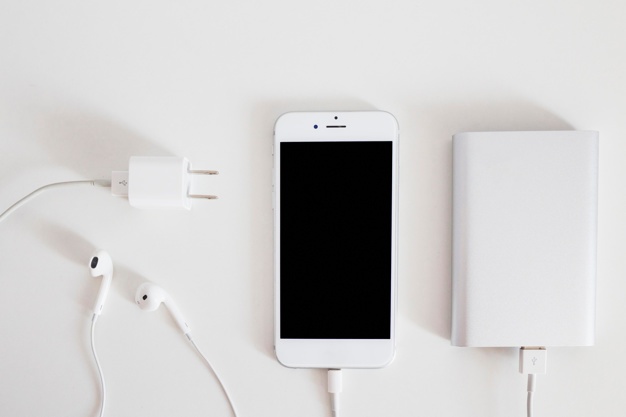
As we all know, electronic products such as mobile phones and tablet computers have brought a lot of convenience to everyone’s life, but frequent charging problems are a headache. One charging cable and one charging head with different size and shape. If you go out without it, you are likely to fall into the embarrassing situation of “losing contact.”
As early as October 2017, the wireless charging mobile phone family welcomed three new members: iPhone 8, iPhone 8 Plus and iPhone X. With its strong influence, Apple has also brought wireless charging technology into the eyes of everyone.
Wireless charging technology has inherent advantages – convenience, it can avoid the phenomenon of “ignition” when plugging and unplugging the charging line, which has no damage to the charging port, and makes the mobile device become one of the earliest “users” of wireless charging technology.
However, how has it passed so long, there are still many people who choose not to trust “wireless charging technology” and insist on charging lines.
From being invented to today, after 140 years of wireless charging technology, we unknowingly “sneaked” into our lives: not only small electronic devices such as mobile phones, tablets, smart watches, but also large equipment such as electric cars. They have all become members of the wireless charging family.
So, let’s first understand how wireless charging is implemented!
Three Principles of Wireless Charging
- Electromagnetic induction wireless charging — too short transmission distance
With the popularity of small electronic products such as mobile phones and the promotion of companies such as Texas Instruments, Philips, Samsung, and Toshiba, electromagnetic induction charging technology has become the most widely used wireless charging technology in small electronic products such as mobile phones.
As the name suggests, electromagnetic induction wireless charging technology uses the principle of electromagnetic induction. This charging system consists mainly of two coils: a primary coil and a secondary coil. First, the primary coil is supplied with a certain frequency of alternating current. Due to the electromagnetic induction, a certain current is generated in the secondary coil, so the energy is transferred from the transmission end to the receiving end.
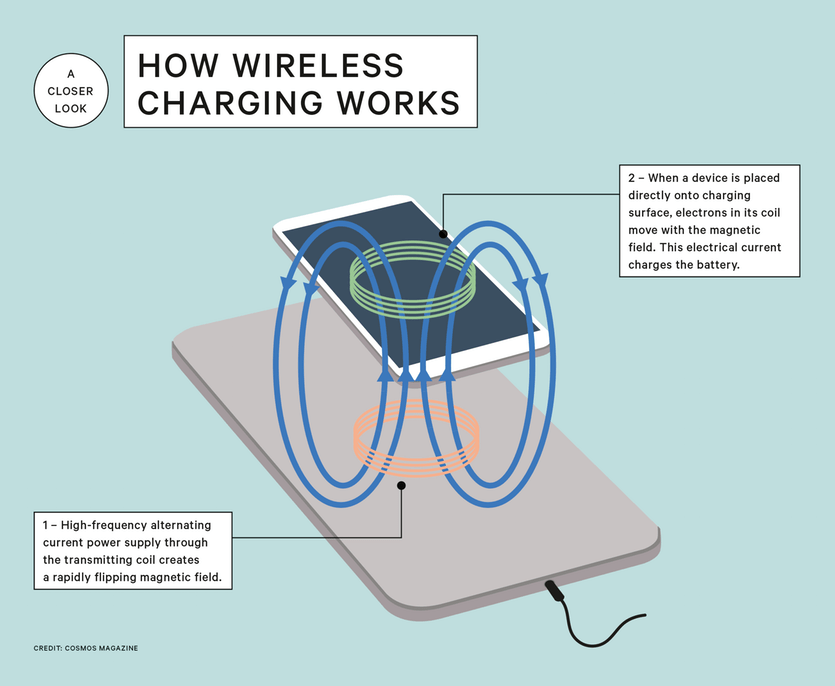
Applying this principle to the mobile phone, there is a primary coil in the charging base, and a secondary coil is built in the mobile terminal. When the mobile phone is close to the charging stand, based on the electromagnetic induction, a certain current is generated in the receiving coil of the mobile phone, and the mobile phone can be charged without the charging line.
However, electromagnetic induction wireless charging technology also has great shortcomings, the most troublesome of which is the limited transmission distance. Currently, this technology has an effective charging distance of only 10 mm, and if the two coil positions are not aligned, problems are likely to occur.
- Magnetic resonance wireless charging — long transmission distance, high power supply efficiency, but need to be frequency modulated
On June 7, 2007, the research team of the Massachusetts Institute of Technology published the results in Science, saying: Successfully “caught” the electromagnetic wave. They used a copper coil as an electromagnetic resonance device, and the transmitting side sent electromagnetic waves of a specific frequency, and then spread the electromagnetic field to the receiving side, and successfully supplied power to a 60-watt bulb that was two meters away.
Therefore, two devices are also required to use such charging: an energy transmitting device and an energy receiving device. And the condition for energy transfer is that the two devices need to be adjusted to the same frequency. For example, two coils act as resonators, and the transmitting end vibrates to the surrounding electromagnetic field at a frequency of 10 MHz, and the receiving end also needs to vibrate at the same frequency of 10 MHz to realize energy transmission.
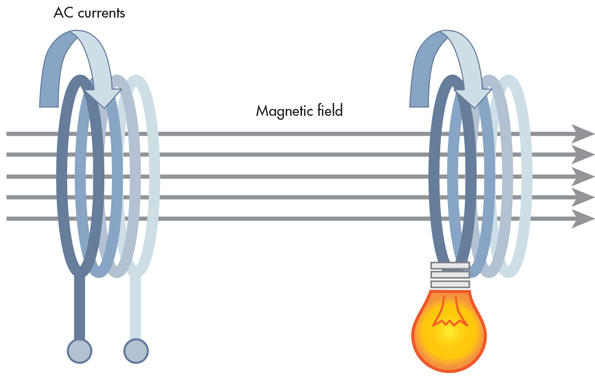
The magnetic vibrator is composed of a large inductance coil in which small capacitors are connected in parallel or in series. Compared to electromagnetic induction, magnetic resonance wireless charging has a longer transmission distance, higher power supply efficiency, and supports a one-to-many power supply mode. But the biggest difficulty is how to get the same frequency for both circuits. Frequency modulation is the most important step in this technology.
- Radio wave transmission — transmission distance up to 10 meters, but low efficiency
The principle of transmitting electricity by radio waves is to convert electromagnetic waves into currents and then pass current through the circuit. The radio wave transmission system is mainly composed of a microwave transmitting device and a microwave receiving device. The microwave transmitting device emits radio waves, and the microwave receiving device captures radio wave energy and adjusts with the load to obtain stable direct current.
In theory, the wireless charging mode transmission distance is farther than the electromagnetic induction mode and the magnetic resonance mode, and can reach more than 10 meters; and it can also realize automatic charging anytime and anywhere. However, this method also has a big disadvantage, that is, relatively low transmission efficiency.
Reasons why wireless charging technology is not popular
Although the wireless charging technology for mobile phones has been proposed for a long time, it is puzzling: After so many years, this technology is still slow, why?
- Limited charging distance
Ordinary mobile phone charger with a charging cable, as well as a suitable charging head or charging treasure; while wireless charging has developed over the years and is only wireless charging within a few tens of millimeters, which means that we still need to bring a charging treasure or a charging head when we go out.
- The stability and efficiency of wireless charging is difficult to achieve
Taking Apple’s 5W wireless charger as an example, considering the transmission efficiency, it takes about 3 hours to fully charge the iPhoneX; it takes nearly 2.5 hours to charge with the 7.5W wireless charger. Although 20W wireless chargers and wireless charging treasures appeared on the market in 2019, its stability and charging efficiency are still a big problem that lingers in the minds of consumers.
- The impact of wireless charging on battery life
Although wireless charging technology has been developed for many years, the largest share of the market is still in the mobile phone field. Therefore, we have to consider: Will wireless charging shorten the service life of mobile phone batteries?
However, because of the wireless charging, we have no trouble with the complicated charging line. Wireless charging treasure can give your mobile phone “power” anytime, anywhere, so wireless charging can greatly facilitate our lives. Perhaps there are still some shortcomings in mobile wireless charging at this stage, but we believe in the power of technology, which will allow us to charge mobile phones and computers anytime, anywhere, in the near future.
 electronics world